East Africa Solar Water Pump Market Growth and Investment Opportunities
Introduction
East Africa is emerging as one of the world’s most dynamic markets for solar water pumping technology. With over 60% of the region’s population lacking reliable access to grid electricity and agriculture contributing 25-40% of GDP across Kenya, Tanzania, Uganda, and Ethiopia, the demand for off-grid water solutions has never been stronger. The East African solar water pump market, valued at approximately USD 180 million in 2025, is projected to grow at a compound annual growth rate (CAGR) of 16.5% through 2030, driven by falling photovoltaic panel costs, expanding government subsidy programs, and increasing climate resilience priorities. For B2B importers, distributors, and agricultural project developers, this represents a rare alignment of commercial opportunity and developmental impact. KINBO, a specialized solar water pump manufacturer with a growing footprint in sub-Saharan Africa, offers competitively priced pump systems engineered for the specific water depth, flow rate, and durability requirements of East African applications. Understanding the market structure, growth drivers, and investment landscape is essential for any business seeking to enter or expand in this region. For guidance on equipment longevity, see our solar pump maintenance guide.
Table of Contents
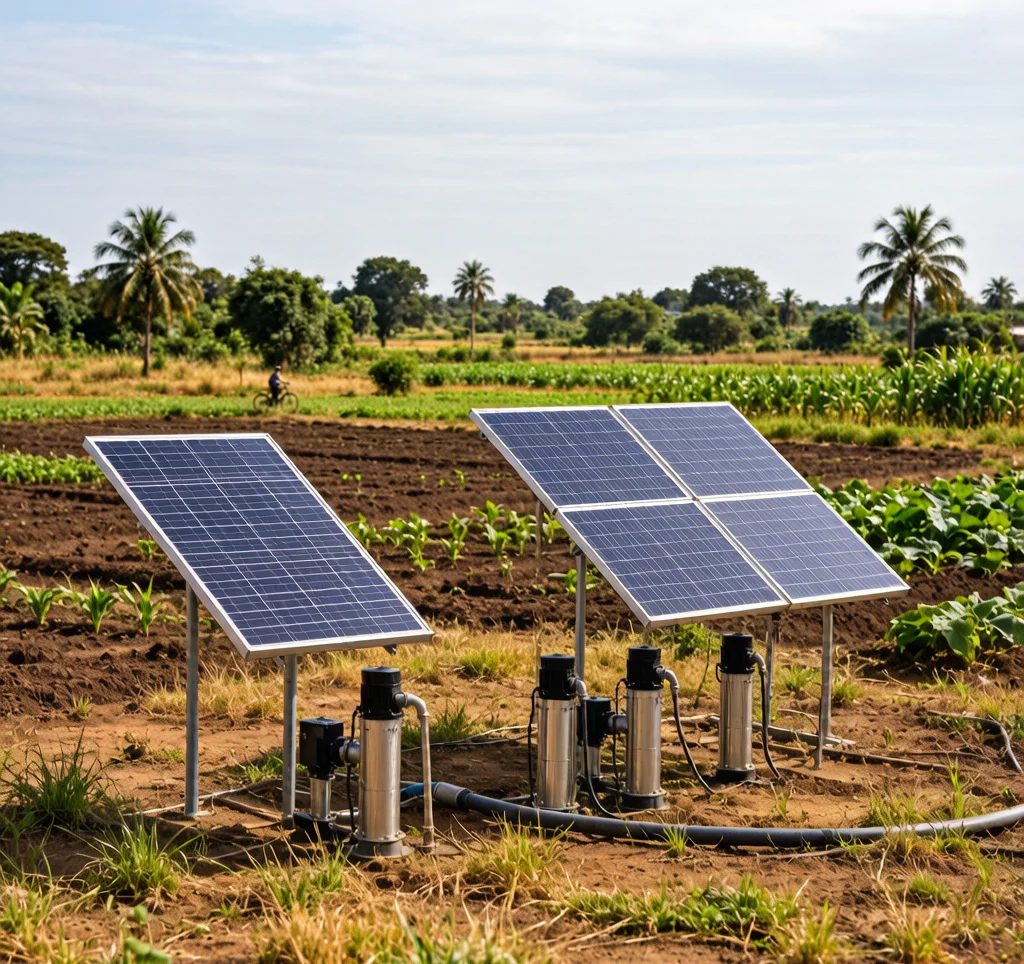
East Africa Solar Pump Market Overview
The East African solar water pump market has experienced remarkable expansion since 2020, fueled by a convergence of technological, economic, and policy factors. Kenya currently holds the largest market share at approximately 35%, supported by its mature mobile money ecosystem (M-Pesa) that enables pay-as-you-go (PAYG) financing models for smallholder farmers. Tanzania follows with roughly 28% of the regional market, benefiting from aggressive rural electrification programs and World Bank-funded water access initiatives. Uganda, at 20%, has seen rapid adoption in the northern and eastern agricultural corridors, while Ethiopia, though representing a smaller 12% share, is projected to achieve the fastest growth rate over the next five years due to large-scale irrigation modernization programs supported by the African Development Bank.
In aggregate, the region installed an estimated 95,000 solar pump units in 2025, up from 42,000 in 2021. The weighted average installed cost per system has declined from USD 2,800 in 2020 to approximately USD 1,900 in 2025, primarily due to reductions in solar panel and controller costs. Market analysts project that the East African solar pump market will exceed USD 380 million by 2030, with the irrigation segment accounting for over 55% of total demand. For KINBO and other manufacturers, the key competitive differentiators include product reliability under high-dust environments, localized after-sales service networks, and compatibility with prevailing PAYG and microfinance payment platforms.
Key Growth Drivers
Multiple structural forces are accelerating solar pump adoption across East Africa:
- Rural Electrification Gap: An estimated 140 million people in East Africa lack access to grid electricity, and extending the grid to remote agricultural areas remains economically unviable. Solar pumping provides a decentralized, immediately deployable alternative that eliminates diesel fuel costs and generator maintenance.
- Agricultural Dependence: Agriculture employs 65-80% of the labor force in East African economies. Reliable irrigation access can double or triple smallholder yields, making water pumping a direct productivity investment rather than a discretionary expense.
- Government Policy Support: Kenya’s National Solar Water Pumping Programme, Tanzania’s Rural Water Supply and Sanitation Agency (RUWASA) initiatives, and Ethiopia’s Green Legacy agricultural modernization strategy all include specific solar pump procurement targets and import duty exemptions on renewable energy equipment.
- International Development Finance: The World Bank, African Development Bank, USAID’s Power Africa initiative, and the Green Climate Fund have collectively committed over USD 2.5 billion to off-grid solar and water access programs in East Africa through 2028. A significant portion of these funds is channeled through procurement tenders accessible to qualified international suppliers.
- Climate Resilience Imperative: Increasingly erratic rainfall patterns have made rain-fed agriculture unreliable across the region. Solar-powered irrigation offers a climate adaptation solution that aligns with national adaptation plans and attracts concessional climate finance.
Market Segmentation by Application
The East African solar pump market can be segmented into four primary application categories, each with distinct technical requirements, market dynamics, and growth trajectories. Understanding these segments is critical for suppliers to align product specifications and go-to-market strategies with end-user needs.
| Segment | Market Share | Growth Rate (CAGR) | Key Countries | Typical Pump Power Range |
|---|---|---|---|---|
| Irrigation | 55% | 18.2% | Kenya, Ethiopia, Tanzania | 1.5 – 7.5 HP (1.1 – 5.5 kW) |
| Livestock Watering | 22% | 14.5% | Tanzania, Kenya, Uganda | 0.5 – 2 HP (0.37 – 1.5 kW) |
| Domestic Water Supply | 15% | 12.8% | Uganda, Tanzania | 0.25 – 1 HP (0.18 – 0.75 kW) |
| Community Supply | 8% | 20.5% | Ethiopia, Kenya | 3 – 10 HP (2.2 – 7.5 kW) |
The irrigation segment dominates both in current volume and anticipated growth, driven by the commercialization of smallholder agriculture and expansion of high-value horticultural export crops such as green beans, avocados, and cut flowers. The community water supply segment, though the smallest in absolute terms, exhibits the highest growth rate as national governments prioritize rural piped water schemes under SDG 6 commitments. Livestock watering remains a stable, recurring-demand segment, particularly in Tanzania’s pastoralist regions where cattle herds require reliable dry-season water sources.
Investment Opportunities and Challenges
For B2B enterprises considering entry into the East African solar pump market, the opportunity landscape is substantial but requires careful navigation of structural challenges:
Opportunities
- Import Tariff Advantages: All four major East African markets (Kenya, Tanzania, Uganda, Ethiopia) offer reduced or zero import duties on solar equipment and components under the EAC Common External Tariff framework and national renewable energy incentive programs. Solar panels, controllers, and DC pumps classified under HS codes 8541.43, 8504.40, and 8413.70 frequently qualify for duty exemptions when accompanied by appropriate certification.
- Distribution Partnerships: The most successful market entry model involves partnering with established in-country distributors who already maintain relationships with agricultural cooperatives, NGOs, and government procurement agencies. Distributors typically seek exclusive territory agreements and require minimum stock-holding commitments of 50-100 units.
- After-Sales Service Infrastructure: Building a certified technician network is both a competitive barrier and a revenue opportunity. End-users consistently rank service availability as their top purchasing criterion. Manufacturers who invest in local training programs and spare parts depots in Nairobi, Dar es Salaam, and Addis Ababa gain significant reputational advantage.
- Innovative Financing Models: The integration of solar pumps with PAYG technology platforms, microfinance institution (MFI) partnerships, and carbon credit monetization mechanisms can unlock price-sensitive market segments. Systems priced between USD 800 and USD 3,500 are increasingly accessible to smallholders through installment payment structures.
Key Challenges
- Logistics and Import Clearance: Port congestion at Mombasa and Dar es Salaam, combined with variable customs clearance timelines, can add 4-8 weeks to delivery schedules. Establishing bonded warehouse facilities in regional logistics hubs mitigates this risk.
- Currency Volatility: Exchange rate fluctuations, particularly for the Ethiopian Birr and Tanzanian Shilling, require pricing strategies that incorporate currency hedging or USD-denominated contracts.
- Counterfeit Competition: The market has seen an influx of low-quality, uncertified solar pumps from unregulated manufacturers. Differentiating through IEC/ISO certification, extended warranties, and verified performance data is essential for premium positioning.
Frequently Asked Questions
1. What is the total addressable market size for solar water pumps in East Africa?
The East African solar water pump market was valued at approximately USD 180 million in 2025 and is projected to surpass USD 380 million by 2030, representing a CAGR of 16.5%. The irrigation segment alone accounts for over USD 99 million of current demand. These figures exclude the substantial addressable opportunity from diesel pump replacement, which represents an additional 500,000+ installed units across the region.
2. Which East African country offers the best entry point for new solar pump importers?
Kenya is widely regarded as the optimal entry market due to its developed logistics infrastructure, stable regulatory environment, mature mobile money ecosystem that supports PAYG financing, and a large base of commercially oriented smallholder farmers. Successful market entry in Kenya also provides a platform for subsequent expansion into Tanzania, Uganda, and Ethiopia through the East African Community (EAC) tariff framework.
3. What technical certifications are required to sell solar pumps in East African markets?
Most East African countries require IEC 62253 compliance for solar pumping systems, ISO 9001 quality management certification for manufacturers, and country-specific certification from national standards bodies such as KEBS (Kenya Bureau of Standards), TBS (Tanzania Bureau of Standards), or UNBS (Uganda National Bureau of Standards). PV modules must meet IEC 61215 and IEC 61730 standards. Products certified under the Global LEAP Awards or VeraSol quality assurance framework typically receive expedited market access.
For B2B buyers targeting East African solar pump markets, contact KINBO for competitive FOB pricing and technical specifications.
August 11, 2026 | Author: KINBO Editorial Team