Solar Panel Tilt Angle Optimization for Solar Water Pumps: A Latitude and Seasonal Guide
Solar Panel Tilt Angle Optimization for Solar Water Pumps: A Latitude and Seasonal Guide
Introduction
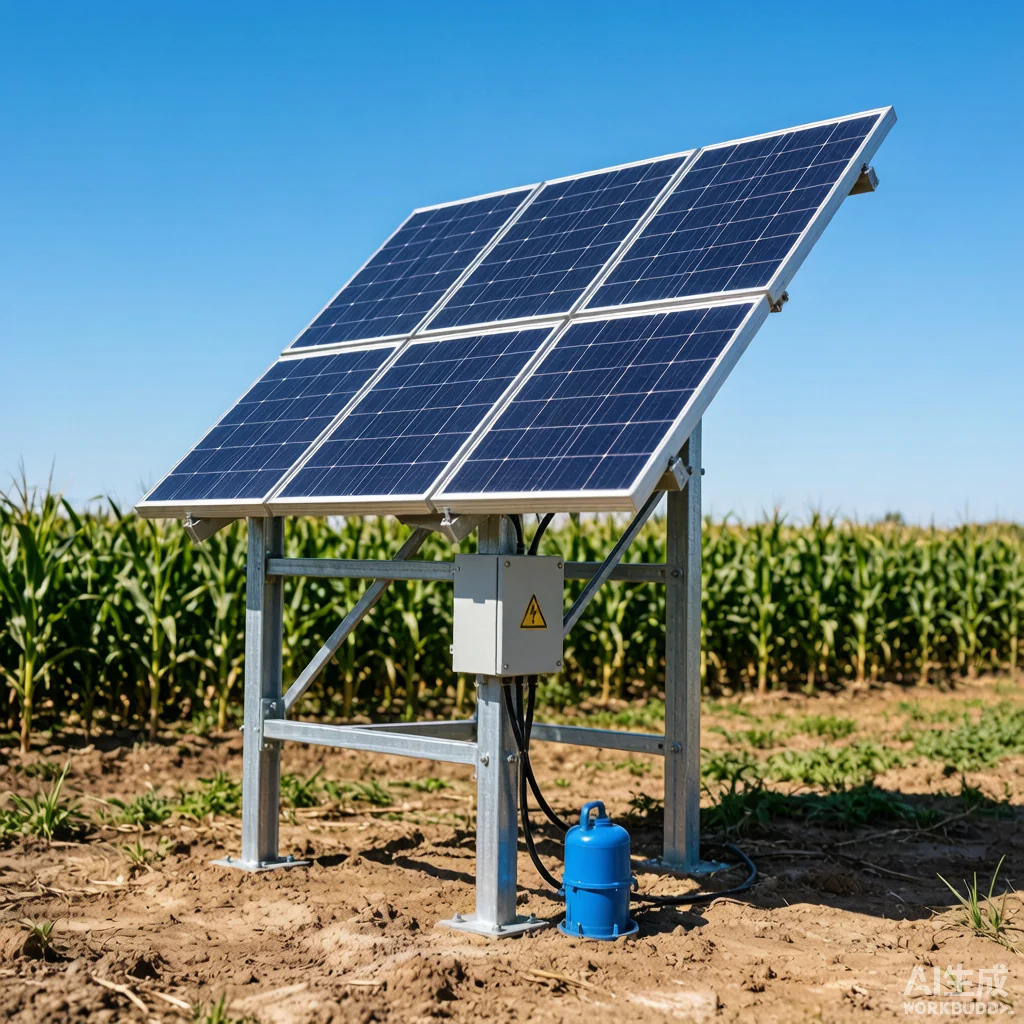
The tilt angle of a solar array is one of the most overlooked variables in solar water pumping system design. A panel angled just 15 degrees away from the optimum can silently surrender 10 to 15 percent of its seasonal energy — and for an irrigation or livestock pump, that lost energy translates directly into fewer cubic meters of water delivered during the months when demand peaks. Getting the angle right costs nothing extra at installation time, yet it is frequently the single highest-value adjustment a system owner can make.
KINBO engineers solar pumping systems for farms, ranches, and off-grid communities across more than 60 countries, spanning latitudes from the equator to northern Europe. In this guide we explain how to calculate the correct tilt for your location, how to adjust for the season, and how to decide between fixed, adjustable, and tracking mounts. For guidance on sizing the array itself, see our companion article on how to configure solar panels for a water pump.
Table of Contents
Why Tilt Angle Matters for Solar Pump Performance
A photovoltaic panel produces maximum power when sunlight strikes its surface perpendicularly, at a 90-degree angle of incidence. When the panel is tilted away from the sun, the effective area that intercepts the light shrinks, and both current and power output fall. The relationship is roughly proportional to the cosine of the incidence angle, which means small angular errors produce modest losses but larger errors compound quickly.
For solar water pumping specifically, the consequences go beyond simple energy loss. A solar pump has no grid backup and no battery in most direct-coupled systems — it only runs while the array produces enough voltage to start and sustain the motor. A poorly tilted array shortens the daily run window in two ways: it delays startup in the morning and shuts the pump down earlier in the afternoon. The result is a pump that delivers noticeably less water per day even when the day is bright and clear.
Three factors determine the optimum tilt at any site:
- Latitude: The primary driver. Panels should face the equator and tilt to match the sun’s elevation angle.
- Seasonal demand pattern: An irrigation pump that only runs in summer should be optimized for summer sun, while a year-round livestock pump needs a balanced angle.
- Local shading and terrain: Hills, trees, and buildings can shift the effective optimum away from the theoretical angle.
Latitude-Based Tilt Formulas and Seasonal Adjustment
The classic starting rule is simple: set the tilt angle equal to the site’s latitude for year-round average performance. At 30 degrees north, for example, you would tilt the array 30 degrees toward the south. This single number works well for systems that must deliver water every month of the year, such as drinking water supplies and livestock watering points.
For systems with strongly seasonal demand, you should bias the tilt toward the season that matters most. The standard adjustments are:
- Summer maximum: Latitude minus 15 degrees. This raises the panel flatter to capture the high summer sun.
- Winter maximum: Latitude plus 15 degrees. This steepens the panel to catch the low winter sun and sheds snow more easily.
- Year-round balanced: Latitude, or latitude plus 5 to 10 degrees if you want a slight winter bias for snow-prone regions.
These rules originate from the sun’s declination, which swings about 23.5 degrees above and below the celestial equator over the year. At the summer solstice, the sun’s noon elevation angle equals 90 minus latitude plus 23.5 degrees, and at the winter solstice it equals 90 minus latitude minus 23.5 degrees. The “latitude plus or minus 15” convention is a practical simplification that captures most of the seasonal variation without requiring continuous adjustment.
For a worked example, consider a KINBO irrigation system installed at 35 degrees north latitude. The year-round optimum is 35 degrees. If the farmer only irrigates from April through September, the ideal summer tilt is 35 minus 15, or 20 degrees. Conversely, a ranch watering cattle through a northern winter would set the panels at 35 plus 15, or 50 degrees, to maximize low-sun capture and help snow slide off the glass.
Fixed vs Adjustable vs Tracking Mounts
Once you know the optimum angle, the next decision is whether to fix the panel in one position or add the ability to adjust it. Each approach has a different cost-benefit profile for solar pumping applications.
| Mount Type | Annual Output Gain | Relative Cost | Best For |
|---|---|---|---|
| Fixed (latitude tilt) | Baseline | Lowest | Year-round water supply, low maintenance budgets |
| Adjustable (2-4x per year) | +5% to +10% | Low (+5-15%) | Seasonal irrigation, manual labor available |
| Single-axis tracker | +15% to +25% | High (+30-50%) | Large commercial arrays over 10 kW |
For most agricultural and community-scale solar pump installations under 10 kW, a fixed mount at the correct latitude tilt, or a simple adjustable mount adjusted two to four times per year, delivers the best return on investment. Trackers add moving parts, motors, and maintenance burden that rarely pay for themselves below the commercial scale. The money saved on a tracker is usually better spent on one or two additional fixed panels, which increase output at a lower installed cost per watt.
Optimal Tilt Angle Quick Reference Table
The table below summarizes recommended tilt angles for common latitude bands across the KINBO service regions. Use it as a starting point and refine with a local solar resource map or site survey.
| Latitude Band | Year-Round Tilt | Summer Tilt | Winter Tilt | Example Regions |
|---|---|---|---|---|
| 0° – 10° | 10° – 15° | 5° – 10° | 10° – 20° | Kenya, Nigeria, Indonesia, Philippines |
| 10° – 25° | Latitude | Lat – 15° | Lat + 15° | India, Mexico, Vietnam, Saudi Arabia |
| 25° – 40° | Latitude | Lat – 15° | Lat + 15° | Egypt, Turkey, USA, Spain, China |
| 40° – 55° | Lat + 5° | Lat – 10° | Lat + 15° | Northern Europe, Canada, Russia |
Practical Installation Considerations
Calculating the right number is only half the job. Several real-world factors can erode the benefit of an optimal tilt if they are ignored during installation.
Orientation: In the northern hemisphere, panels should face true south (not magnetic south), and in the southern hemisphere they should face true north. A compass reading must be corrected for magnetic declination, which can exceed 10 degrees in some regions and cause a meaningful output loss.
Snow and dust: In snow-prone areas, a steeper winter tilt of 45 degrees or more helps snow shed naturally and keeps the array producing through the winter. In dusty or sandy regions, a tilt of at least 10 to 15 degrees lets rain wash debris off the glass; a flat panel accumulates a dust film that can cut output by 10 to 20 percent between cleanings.
Shading: A few hours of morning or afternoon shade from a tree or building can offset the entire gain from correct tilt. When possible, install the array with an unobstructed view of the sky during the pump’s expected run window, and trim vegetation that will grow over time.
Wind loading: Steeper tilts catch more wind. In storm-prone coastal or highland sites, reinforce the mounting structure and bolts, and consider a slightly lower tilt if wind loading is the dominant design constraint. For more on protecting the full electrical system, see our guide to how solar water pumps work.
Frequently Asked Questions
What is the best tilt angle for a solar water pump panel?
A common rule of thumb is to set the tilt angle equal to the site’s latitude for year-round average performance. For maximum summer output, subtract 15 degrees from latitude; for maximum winter output, add 15 degrees. A fixed tilt equal to latitude is usually the best compromise for solar water pumping.
How much does tilt angle affect solar pump daily water output?
A tilt error of 15 to 20 degrees typically reduces annual energy capture by only 3 to 8 percent, but seasonal output can drop by 15 percent or more during the critical irrigation months. Correct tilt is especially important for irrigation pumps that must meet peak summer water demand.
Are adjustable mounts or solar trackers worth the cost for solar pumps?
Adjustable mounts that let you change tilt 2 to 4 times per year boost annual output by 5 to 10 percent at low cost and are usually worthwhile. Single-axis solar trackers can add 15 to 25 percent output but are generally not cost-effective for small pump systems because the extra cost is better spent on additional fixed panels.
Should solar pump panels face south or north?
Panels should face the equator: true south in the northern hemisphere and true north in the southern hemisphere. Correct for magnetic declination using a local map, because a compass alone can be off by several degrees.
Need Help Optimizing Your Solar Pump Array?
The KINBO engineering team can calculate the optimal tilt and array size for your exact latitude and water demand. Get expert guidance and full after-sales support.
August 14, 2026 | Author: KINBO Editorial Team
Related Articles