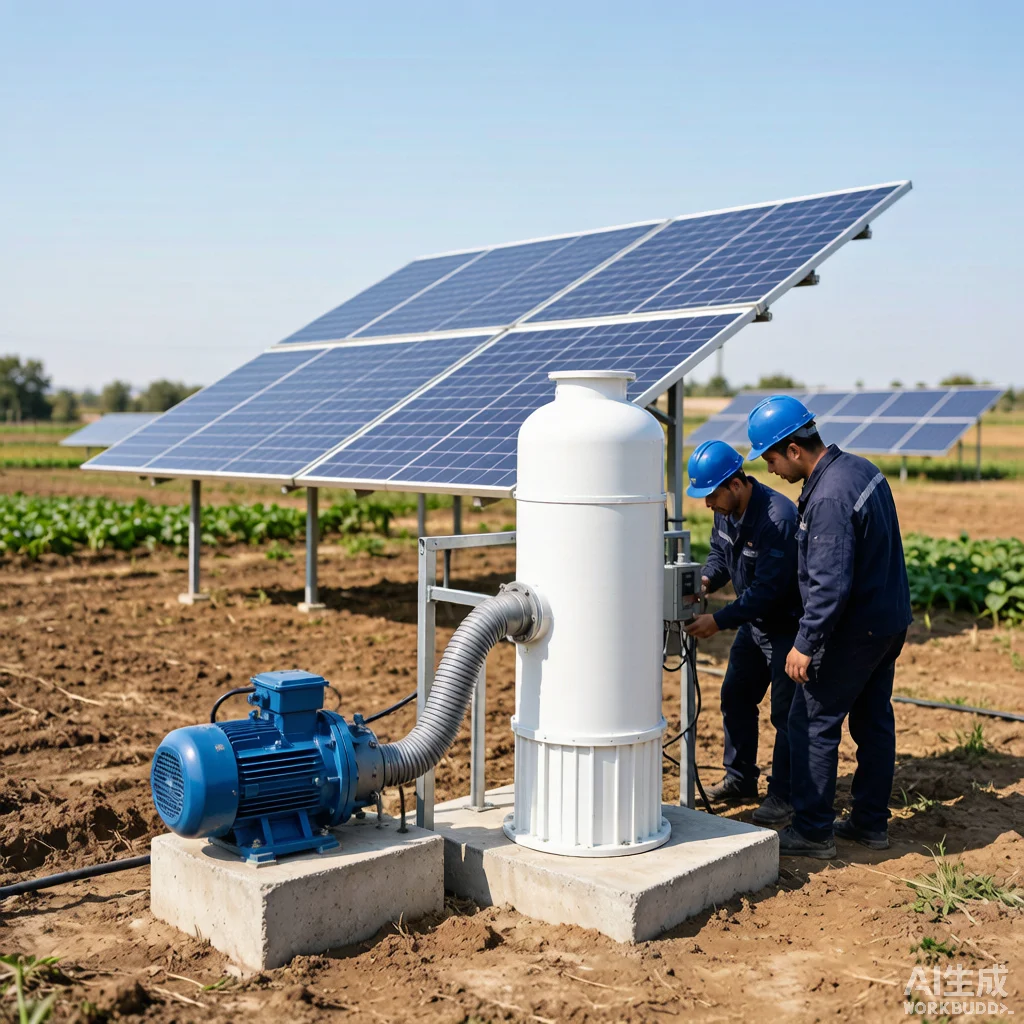
Solar Pump Digital Transformation: IoT, AI, and Smart Monitoring
Introduction
The convergence of low-cost IoT hardware, cloud computing, and machine learning is transforming solar water pumping from an isolated mechanical operation into a connected, data-driven service. KINBO is actively integrating smart monitoring capabilities across its product lines to enable real-time performance tracking, predictive maintenance scheduling, and fleet-level optimization that directly benefits B2B buyers managing distributed pump installations across large geographical areas. The economic rationale is compelling: unplanned pump downtime in agricultural irrigation can cost $50-500 per hour in lost crop yield during critical growth stages, while reactive maintenance is typically 3-5 times more expensive than planned intervention. A solar pump equipped with IoT telemetry, edge computing, and cloud-based analytics can detect incipient failures days or weeks before they cause a shutdown, automatically adjust operating parameters to maximize daily water output under variable irradiance, and provide installers and OEMs with the usage data needed to optimize future product design. This article examines the IoT architecture underpinning smart solar pump monitoring, the AI and machine learning techniques used for predictive maintenance and performance optimization, fleet management strategies for multi-site operators, and the data security and interoperability standards that govern industrial IoT deployments.
Table of Contents
1. IoT Architecture for Solar Pump Monitoring
A robust IoT architecture for solar pump monitoring follows a four-layer model: sensing and data acquisition at the pump and controller level, edge processing and local communication for preliminary data reduction, cloud connectivity and data ingestion for centralized storage and analytics, and application and visualization for user-facing dashboards, alerts, and reports. At the sensing layer, a minimally instrumented solar pump installation requires the following measurement points: PV array DC voltage and current (for MPPT performance tracking and array health diagnostics), motor phase currents and voltages (for electrical efficiency calculation and fault detection), pump discharge pressure (via 4-20 mA or 0-5V pressure transducers with 0.5% FS accuracy), flow rate (via electromagnetic or ultrasonic flow meters, ±1% accuracy preferred), water level sensors at the source and storage tank, and motor winding temperature via embedded RTD or thermistor elements. Optional sensors include vibration accelerometers on the pump-motor assembly for bearing condition monitoring, water quality parameters (TDS, pH, turbidity) for treatment applications, and meteorological sensors (pyranometer, ambient temperature) for solar resource correlation.
The edge processing layer typically resides in the pump controller or a dedicated IoT gateway module. Modern MPPT pump controllers already contain microcontrollers with significant spare processing capacity and non-volatile memory, making them natural platforms for embedded IoT functionality without requiring separate hardware. The edge processor performs several critical functions: sensor signal conditioning and analog-to-digital conversion, data timestamping with GPS or network-synchronized time, local data buffering (typically 7-30 days of 5-minute interval data stored on SD card or flash memory to survive communication outages), threshold-based alarm generation (e.g., motor over-temperature, dry-run detection, low flow), and data compression before transmission—reducing a raw 1 Hz sensor stream to aggregated 5-15 minute statistical summaries (min, max, mean, standard deviation) that capture essential operating characteristics while reducing bandwidth requirements by 95% or more. Communication from the edge to cloud uses either cellular (4G LTE-M or NB-IoT for wide-area coverage with low power consumption, typically 0.5-2 MB/month per pump at 10-minute reporting intervals), LoRaWAN for remote sites beyond cellular coverage (gateway range up to 15 km line-of-sight, data rates 0.3-50 kbps sufficient for telemetry only), or satellite IoT (Iridium or Inmarsat M2M) for the most isolated installations. The cloud layer ingests data via MQTT or HTTP REST APIs into time-series databases (InfluxDB, TimescaleDB) optimized for high-write-throughput sensor workloads, with processing pipelines for data validation, gap filling, derived metric calculation, and anomaly detection running as serverless functions or containerized microservices.
2. Predictive Maintenance with AI and Machine Learning
Predictive maintenance for solar pumps shifts the service paradigm from reactive (fix after failure) or scheduled (replace components at fixed intervals regardless of condition) to condition-based maintenance, where interventions are triggered by data-driven degradation indicators. The machine learning approach to failure prediction operates on three fundamental data categories: electrical signatures (motor current signature analysis detecting rotor bar faults, stator winding degradation, and bearing defects through frequency-domain analysis of phase current waveforms), hydraulic performance trends (progressive decline in flow rate at constant head indicating impeller wear, increasing power consumption for the same hydraulic output suggesting mechanical friction or electrical degradation), and environmental context (cumulative operating hours, average load factor, number of dry-run events, water quality parameters correlating with corrosion or scaling rates).
The most effective predictive models for solar pump applications employ a hybrid approach combining physics-based degradation models with data-driven anomaly detection. Physics-based models use known failure mechanisms—such as the Paris-Erdogan law for fatigue crack propagation in shafts, Archard wear equation for bearing surface degradation, and Arrhenius-based thermal aging models for insulation materials—parameterized with manufacturer design data and field-measured operating conditions. These models provide a physically grounded estimate of remaining useful life (RUL) that generalizes beyond the training data distribution. Data-driven anomaly detection supplements these models using unsupervised techniques: autoencoder neural networks trained on normal operating data learn a compressed representation of healthy pump behavior, and reconstruction error spikes when input patterns deviate from this manifold—indicating an incipient fault. Isolation Forest and One-Class SVM algorithms serve as complementary anomaly detectors, identifying multivariate outliers in the operating parameter space. Supervised classification models (XGBoost, random forest) trained on labeled historical failure data provide specific fault type identification—distinguishing between impeller cavitation, bearing degradation, and electrical insulation breakdown based on their distinct multi-sensor signatures.
Field validation data from agricultural and municipal pumping installations demonstrates that AI-based predictive maintenance achieves 85-92% detection accuracy for major failure modes (motor bearing failure, impeller wear, seal leakage) with a median warning lead time of 2-4 weeks before functional failure. False positive rates for alarm generation are typically below 5% when using ensemble models that require consensus from multiple detection algorithms before issuing a maintenance alert. The key to achieving this performance is training data quality: a minimum of 12 months of historical sensor data spanning at least one complete seasonal operating cycle, including both normal operation and documented failure events, is recommended for building robust models for a specific pump model and application context.
3. Remote Performance Optimization and Fleet Management
For B2B customers managing tens or hundreds of solar pump installations across dispersed geographical locations—typical scenarios include national agricultural extension programs, large-scale irrigation schemes, mining dewatering operations, and municipal water utilities—fleet-level remote management generates value through four mechanisms. Comparative performance benchmarking uses normalized metrics (specific water output in m³/kWh, wire-to-water efficiency as percentage, capacity factor as ratio of actual to nameplate daily output) to rank all pumps in the fleet and identify underperforming units for investigation. A pump consistently producing 20% less water per kWh than its identical siblings at comparable solar resource typically indicates a correctable issue: partially clogged intake screen, misconfigured controller parameters, degraded motor insulation, or suboptimal panel orientation. Fleet management dashboards surface these outliers through automated statistical process control (SPC) charts, with control limits set at ±2-3 standard deviations from fleet mean for each metric.
Dynamic operating parameter optimization leverages the cloud platform to push configuration updates to individual pump controllers based on learned seasonal patterns and current conditions. For example, a pump serving irrigation demand that varies by crop growth stage can receive updated flow setpoints weekly, matching water delivery precisely to evapotranspiration requirements without requiring a site visit. Similarly, MPPT voltage sweep parameters can be adjusted remotely when degradation analysis detects individual PV module underperformance—compensating for partial shading, soiling, or aging effects without physical intervention. Automated dispatch and workforce management integrates predictive maintenance alerts with a computerized maintenance management system (CMMS) to automatically generate work orders, assign technicians based on skill set and geographical proximity, and track repair completion and parts consumption. For large fleets, this automation reduces the mean time to repair (MTTR) from days to hours by eliminating the manual steps of fault detection, diagnosis, and technician assignment. Lifecycle cost analytics aggregate maintenance history, energy consumption, and water production data across the fleet to calculate total cost of ownership (TCO) per cubic meter delivered, informing future procurement decisions and enabling OEMs like KINBO to demonstrate quantifiable reliability advantages over competitors.
4. Data Security and Integration Standards
The expansion of solar pump connectivity introduces cybersecurity risks that must be addressed through defense-in-depth strategies aligned with established industrial IoT security frameworks. The IEC 62443 series of standards for industrial automation and control system security provides the most relevant guidance, defining security levels (SL 1-4) and requiring measures including device identity management, encrypted communications, access control, and audit logging. At the device level, each IoT-enabled pump controller should incorporate a unique hardware-based identity (TPM or secure element chip) for cryptographic authentication, preventing device spoofing and unauthorized firmware modification. Over-the-air (OTA) firmware updates must be digitally signed and verified before installation, with rollback capability in case of failed updates. Communication security between edge devices and cloud platforms uses TLS 1.3 with mutual authentication, ensuring both the device authenticates the server and the server authenticates the device. For cellular-connected pumps, a VPN or private APN connection isolates pump telemetry traffic from the public internet.
Data integration standards enable solar pump monitoring data to flow seamlessly into broader enterprise systems. MQTT Sparkplug has emerged as the preferred protocol for industrial IoT data exchange, extending the lightweight MQTT publish-subscribe protocol with a defined topic namespace, payload format (Google Protocol Buffers), and state management for industrial devices. This allows pump telemetry to be consumed by SCADA systems, building management systems (BMS), and enterprise resource planning (ERP) platforms without custom integration development. For REST API-based integration, the OGC SensorThings API standard (ISO 19156:2023) provides a standardized RESTful interface for IoT sensor data with built-in support for geospatial queries (essential for location-based pump search), historical data retrieval with time-range filtering, and MQTT-based real-time data streaming. Open-source data platforms such as ThingsBoard and Node-RED provide configurable middleware for protocol translation, data transformation, and dashboard creation, reducing vendor lock-in and enabling customers to maintain data sovereignty over their pump operating history. For regulatory compliance in sectors such as municipal water supply and mining, the monitoring system must support automated report generation for water abstraction permits, energy consumption declarations, and environmental compliance documentation—all generated from the same IoT data stream that drives operational optimization.
Frequently Asked Questions
Q: What sensors are needed for IoT pump monitoring?
A: The essential sensor suite for IoT-enabled solar pump monitoring consists of six measurement points at minimum. Electrical parameters: PV input voltage and current (DC), motor phase currents and voltages (AC or DC depending on motor type), measured at the controller with 0.5-1% accuracy. Hydraulic parameters: pump discharge pressure via a 4-20 mA pressure transmitter with 0.5% FS accuracy and burst pressure rating at least 1.5× system maximum; flow rate via electromagnetic flow meter with ±1% of reading accuracy for clean water applications, or clamp-on ultrasonic for retrofit installations where pipe modification is impractical. Level sensing: submersible hydrostatic level transmitter (4-20 mA, 0.25% FS) for borehole water level monitoring and ultrasonic or radar level sensors for storage tanks. Temperature: motor winding temperature via embedded PT100 RTD or NTC thermistor with ±1°C accuracy. Optional but valuable additions include triaxial vibration sensors (MEMS accelerometers, ±16g range, 0.1-2,000 Hz bandwidth) for bearing and impeller condition monitoring, water quality multi-parameter probes (TDS, pH, temperature), and a pyranometer or reference cell for solar irradiance measurement enabling MPPT tracking efficiency calculation. Total sensor hardware cost for the essential suite is approximately $200-400 at OEM quantities, with the flow meter typically accounting for 40-50% of this figure.
Q: How accurate is AI-based failure prediction?
A: The accuracy of AI-based failure prediction for solar pumps depends heavily on training data quality, model methodology, and failure mode. For well-documented failure modes with clear precursor signatures—including motor bearing degradation (detectable through vibration spectrum sidebands around the bearing characteristic frequencies and progressive increase in motor current imbalance), impeller wear/cavitation (manifested as declining pump efficiency and flow-head curve degradation, with cavitation producing distinctive high-frequency vibration in the 5-20 kHz range), and seal leakage (indicated by declining insulation resistance in submersible motors or progressive increase in leakage current)—field-validated accuracy ranges from 85-92% with a false positive rate below 5% when using ensemble detection methods. For less predictable failures such as sudden foreign object impact on impellers, lightning-induced controller damage, or manufacturing defects that manifest without gradual degradation, AI prediction accuracy drops below 50% because these events lack measurable precursor signatures in sensor data. The median warning lead time of 2-4 weeks for the detectable failure modes depends on the degradation rate: bearing wear typically generates detectable vibration changes 3-6 weeks before functional failure under continuous operation, while impeller erosion in abrasive water conditions may progress from initial detection to functional failure in 1-2 weeks. Models improve continuously as more failure events are documented: a system managing 100+ pumps will typically accumulate enough failure cases within 6-12 months of deployment to train production-grade predictive models, provided that all failure events are properly labeled with root cause, component affected, and the date of first observable anomaly.
Q: What is the ROI of smart monitoring systems?
A: The return on investment for IoT-enabled smart monitoring of solar pumps derives from three primary value streams. Avoided downtime cost is the dominant factor: for a 7.5 kW irrigation pump delivering water valued at $0.10/m³ and producing 500 m³/day during growing season, a single avoided 3-day breakdown (the typical time from failure detection to repair completion in rural areas without IoT) recovers $150 in water production value plus avoided emergency repair premium—commonly 2-3× standard service call rates due to after-hours dispatch. At a typical failure rate of 0.5-1.0 major failures per pump per year, reducing downtime by 50% through early detection saves $75-150/year in direct value, with 2-4 pumps covering the $500-800 one-time IoT hardware installation cost per pump within the first year. Extended equipment life contributes additional savings: bearing replacement at the optimal time (based on actual condition rather than fixed schedule or failure) extends motor life by 15-25%, reducing the effective annualized capital cost of the pump. For a $2,500 pump with a 10-year design life, a 20% life extension saving $50/year in amortized cost. Energy optimization through automated MPPT tuning, panel cleaning alerts triggered by irradiance-normalized power output decline, and dynamic flow scheduling yields 5-12% energy savings—approximately $30-100/year at typical solar electricity values. The combined annual benefit of $150-300 per pump against a $500-800 IoT hardware investment and $50-100/year in cellular data costs yields a payback period of 1.5-3 years, with net positive return from year 3 onward. For fleet operators managing 50+ pumps, the additional savings from reduced technician travel (remote diagnostics eliminating 60-70% of site visits for non-critical issues) and inventory optimization (reduced spare parts stock due to predictable maintenance scheduling) typically push the fleet-level payback below 2 years.
To discuss IoT integration options for your KINBO solar pump fleet or request a smart monitoring pilot program, contact the technical support team at KINBO.