Solar Pump MPPT vs PWM Charge Controller: Efficiency Comparison and Selection Guide
Introduction
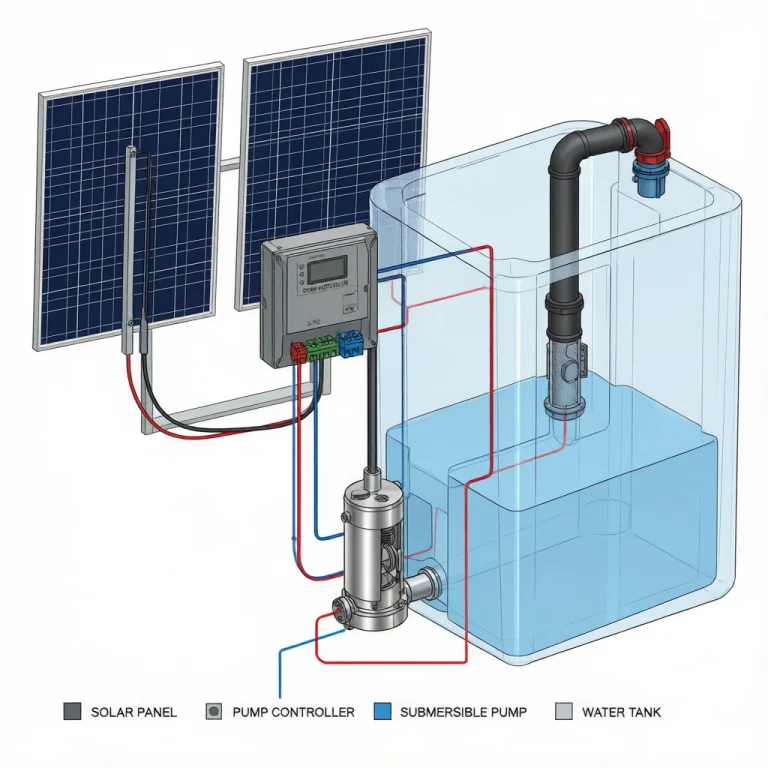
Solar water pumping systems rely on charge controllers to regulate the power flowing from photovoltaic panels to the pump motor. The two dominant controller technologies — MPPT (Maximum Power Point Tracking) and PWM (Pulse Width Modulation) — differ fundamentally in how they extract and convert solar energy, and that difference directly impacts water output, energy yield, and long-term operating costs.
For B2B buyers engineering solar pumping installations, choosing between these technologies is not simply a matter of price. A controller that underperforms in partial shading or cold-morning conditions can reduce daily water delivery by 20–35%, undermining project economics. At KINBO, we have manufactured and tested both controller types across thousands of solar pump deployments. For foundational context, see our solar water pump working principle guide.
Table of Contents
What Is MPPT and PWM Technology in Solar Pump Controllers
Both MPPT and PWM controllers sit between the solar array and the pump, but they manage the electrical interface in very different ways.
MPPT — Maximum Power Point Tracking
An MPPT controller continuously scans the voltage–current curve of the solar array to find the operating point where the panels deliver maximum power (the “knee” of the I-V curve). It then uses a DC-DC converter (typically buck or buck-boost topology) to match the pump motor’s voltage requirements while transferring the maximum available wattage. Because it actively tracks the power point, MPPT adapts in real time to changes in irradiance, temperature, and shading.
PWM — Pulse Width Modulation
A PWM controller connects the solar array directly to the pump (or battery) and regulates output by rapidly switching the connection on and off at a variable duty cycle. When the circuit is “on,” the pump sees the full panel voltage; when “off,” it sees none. This pulls the panel operating voltage down toward the battery or motor voltage, so the array rarely operates at its maximum power point. PWM is electrically simpler — no DC-DC conversion stage — making it cheaper but less efficient at extracting available energy.
Efficiency Comparison: MPPT vs PWM
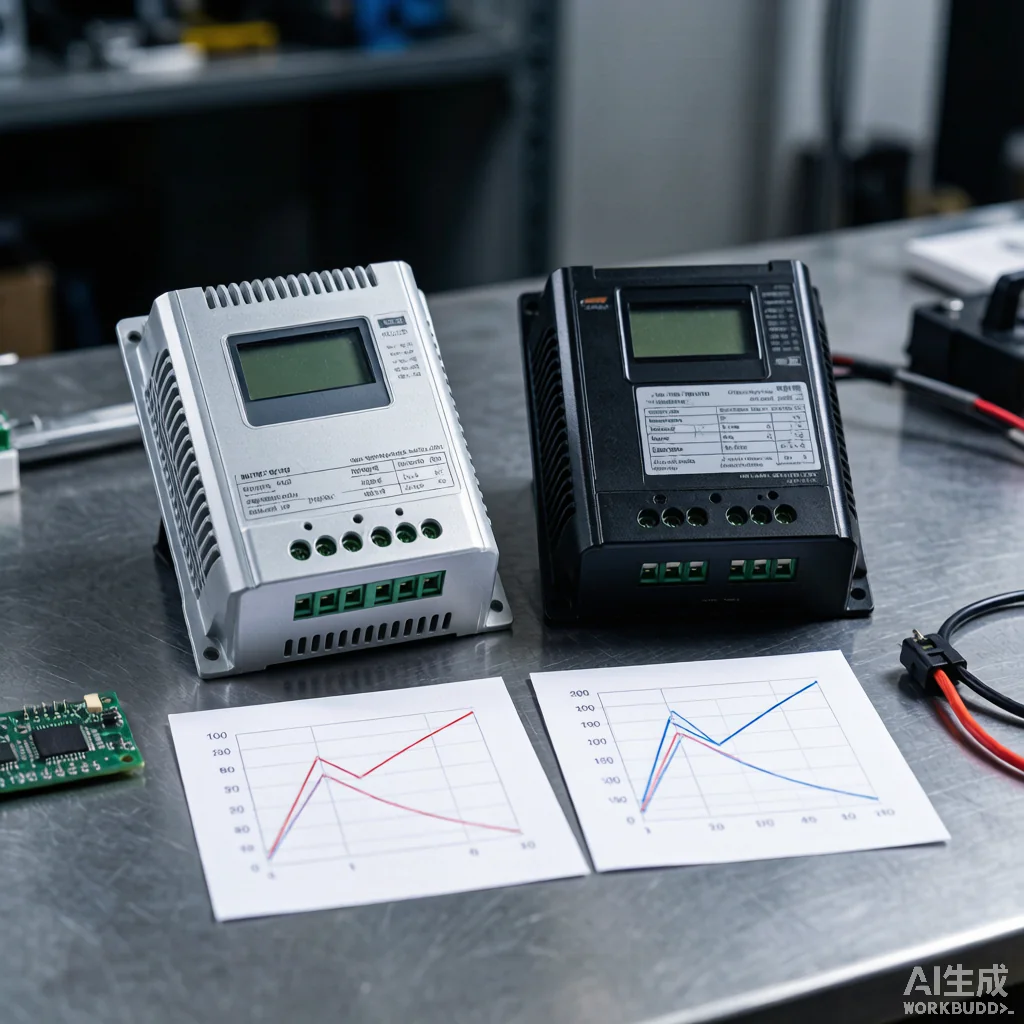
The efficiency gap between MPPT and PWM is most pronounced under real-world, non-ideal conditions. The table below summarizes the key performance parameters:
| Parameter | MPPT | PWM |
|---|---|---|
| Tracking Efficiency | 97–99% | 70–80% |
| Power Conversion Loss | 2–5% (DC-DC stage) | Minimal switching loss, but significant energy left unharvested |
| Low-Light Performance | Excellent — adjusts voltage to maintain power point | Poor — panel voltage drops below load, output collapses |
| Partial Shading Response | Tracks local MPP; some advanced models scan multiple peaks | No tracking; output falls to lowest-irradiance string |
| Cold Morning Boost | 15–35% extra energy harvested (panel Vmp rises in cold) | No cold-weather advantage; excess voltage wasted |
| Array Voltage Flexibility | High — can step down from e.g. 72V array to 24V pump | Limited — panel Vmp must match load voltage closely |
Under standard test conditions (1000 W/m², 25 °C), both controllers deliver similar peak output. The divergence appears in the field: early mornings, cloudy intervals, dust, and seasonal temperature swings push the maximum power point away from the fixed voltage that PWM assumes. Across these conditions — the majority of real operating hours — MPPT maintains 97–99% tracking efficiency while PWM drops to 70–80%, leaving a substantial fraction of available solar energy unused.
For a deeper technical breakdown of tracking algorithms, see our article on MPPT controller solar pump efficiency.
When to Choose MPPT vs PWM Controllers
There is no universal answer — the right choice depends on system architecture, budget, and operating environment. Consider the following decision factors:
- Budget constraints: PWM controllers cost 40–60% less upfront. For small systems (under 200W) where the absolute energy difference is minor, the cost savings may justify the efficiency loss.
- System size: Systems above 500W benefit significantly from MPPT because the 20–30% additional harvested energy translates to materially more daily water volume.
- Climate conditions: In regions with frequent cloud cover, dust, or large day-night temperature swings, MPPT’s adaptive tracking recovers energy that PWM cannot reach.
- Pump type: DC submersible pumps with wide voltage ranges pair well with MPPT. AC pumps driven through inverters almost always require MPPT front-ends to maintain stable DC bus voltage.
- Array-to-load voltage mismatch: If panel string voltage is much higher than the pump’s rated voltage (e.g., a 72V array feeding a 24V pump), MPPT’s DC-DC conversion is essential — PWM would clamp the array to 24V and waste the excess voltage.
Cost-Benefit Analysis and ROI Comparison
To quantify the trade-off, consider a representative 1.5 kW solar pumping system running 6 hours of average equivalent full-load sun per day:
| Metric | MPPT System | PWM System |
|---|---|---|
| Controller Cost (FOB) | $180–$350 | $70–$140 |
| Daily Energy Harvested | ~8.8 kWh | ~6.5 kWh |
| Daily Water Output | ~22 m³ | ~16 m³ |
| Annual Extra Water | +2,190 m³/year | Baseline |
| Extra Cost (vs PWM) | $110–$210 more | — |
| Payback Period | 8–14 months | — |
For most commercial and agricultural installations, the payback window of 8–14 months makes MPPT the clear economic choice. The extra water volume — over 2,000 m³ per year in this example — directly translates to irrigation revenue or reduced diesel-generator backup costs. KINBO engineers recommend MPPT for all systems above 500W or any installation where daily water output is the critical performance metric.
Frequently Asked Questions
Can I upgrade an existing PWM solar pump system to MPPT later?
Yes, in most cases. MPPT controllers are drop-in replacements as long as the input voltage range and current rating match your solar array and pump specifications. However, if your existing array was sized for PWM (matching panel voltage to pump voltage), you may not capture the full MPPT advantage until you reconfigure the array for higher voltage. Contact KINBO’s technical support for a compatibility assessment.
Does MPPT work better in cloudy or shaded conditions?
Yes — this is where the efficiency gap is widest. Under partial shading, the array’s I-V curve develops multiple local maxima. Advanced MPPT controllers with scanning algorithms can identify and lock onto the global maximum, recovering 15–30% more energy than PWM. PWM has no tracking capability, so a shading event pulls the entire array down to the lowest-performing string.
Is PWM ever the better choice for a solar pump?
PWM is viable for small, budget-sensitive systems (typically under 200W) operating in consistently high-irradiance climates where the array voltage closely matches the pump voltage. Examples include small garden fountains or livestock trough pumps in tropical regions. In these cases, the 20–30% efficiency loss represents a small absolute energy difference, and the cost savings may be justified. For any commercial or agricultural pumping application, MPPT is the recommended choice.
For B2B buyers selecting solar pump controllers, contact KINBO for competitive FOB pricing and technical specifications.
Related Articles: