Solar Pump Water Storage Tank Sizing and Configuration Guide
Introduction
Solar water pumping systems have become the go-to solution for off-grid water supply across agriculture, livestock, and rural communities. However, even the most efficient solar pump cannot deliver consistent water flow when the sun goes down or behind clouds. That is where a properly sized water storage tank becomes essential—acting as the critical bridge between intermittent solar energy production and continuous water demand.
At KINBO, we have helped thousands of customers design solar pumping systems that balance daily water demand, pump capacity, and storage volume. Getting the storage tank sizing wrong can lead to water shortages during peak demand or wasted energy during peak sun hours. This guide walks you through the engineering principles, calculation methods, material selection, and configuration best practices to ensure your solar pump system performs reliably year-round. For more on selecting the right pump for your application, check out our guide on how to choose a solar water pump.
Table of Contents
Why Water Storage Matters in Solar Pump Systems
Solar energy is inherently intermittent. A solar pump only operates at full capacity during peak sunlight hours—typically 4 to 6 hours per day depending on location and season. But water demand rarely follows the same schedule. Livestock need water at dawn and dusk, households draw water throughout the day, and irrigation often runs at night to reduce evaporation losses.
A well-sized storage tank solves three fundamental problems in solar pumping systems:
- Solar Intermittency Buffer: The tank stores excess water produced during peak sun hours, making it available when the pump is not running. Without storage, all energy harvested outside of demand periods is effectively wasted.
- Demand Matching: Peak water demand rarely coincides with peak solar output. A storage tank decouples pump operation from consumption, allowing the system to meet flow rate requirements that exceed the pump’s instantaneous output.
- System Protection: Buffer storage prevents the pump from rapid cycling on and off when demand fluctuates, reducing mechanical wear and extending the life of controllers and motor components.
In practice, the storage tank acts as the system’s “battery”—but far cheaper and more durable than electrical energy storage. A properly configured tank can cost 5 to 10 times less per stored liter than a comparable battery bank, making it the most cost-effective way to achieve 24/7 water availability with a solar pump.
How to Calculate Storage Tank Size
Sizing a storage tank requires three key inputs: daily water demand, desired autonomy days, and the solar pump’s effective daily output. The goal is to ensure the tank can hold enough water to bridge the gap between production and consumption.
Step 1: Determine Daily Water Demand
Calculate total daily consumption based on end-use. Common benchmarks: 50 liters per person per day for domestic use, 40 liters per head of cattle per day, and 5–10 mm per square meter for drip irrigation.
Step 2: Determine Autonomy Days
Autonomy days represent how many days the system should supply water without any solar input. For most regions, 2 to 3 days is standard. Cloudy or monsoon-prone areas may require 3 to 5 days.
Step 3: Calculate Required Tank Volume
The basic formula is:
Tank Volume = Daily Demand × Autonomy Days + Safety Margin (15%)
Practical Example: For a 5 kW solar pump serving a community of 200 people, the daily water demand is 200 × 50 = 10,000 liters/day. With 2 autonomy days: 10,000 × 2 = 20,000 liters. Adding a 15% safety margin: 20,000 × 1.15 = 23,000 liters. Rounding up, a 25,000-liter tank is recommended. To verify your pump can fill this within available sun hours, check the pump’s daily output against the fill volume—our guide on calculating required head covers pump output calculations in detail.
Tank Types and Material Selection
Selecting the right tank material depends on capacity requirements, site conditions, budget, and water quality. Below is a comparison of the four most common storage tank materials used in solar pumping systems.
| Material | Capacity Range | Lifespan | Cost Level | Best Application |
|---|---|---|---|---|
| HDPE / Polyethylene | 500 – 50,000 L | 15–25 years | Low | Residential, small farms, livestock watering |
| Steel (Galvanized/Stainless) | 5,000 – 500,000 L | 20–40 years | Medium–High | Community water supply, industrial use |
| Concrete (RCC) | 10,000 – 1,000,000+ L | 40–60 years | High | Large-scale irrigation, municipal projects |
| Bladder / Flexible | 1,000 – 100,000 L | 10–15 years | Low–Medium | Temporary installations, space-constrained sites |
For most small to mid-sized solar pump installations, HDPE tanks offer the best balance of cost, durability, and ease of installation. For large community or agricultural systems requiring 50,000 liters or more, steel or concrete tanks are typically more economical on a per-liter basis.
Configuration Best Practices
How you physically configure the storage tank relative to the pump and distribution system significantly impacts performance, energy efficiency, and maintenance requirements. Here are the key configuration principles:
Elevated vs. Ground-Level Tanks: Elevated tanks use gravity to deliver consistent water pressure without additional energy input. A tank elevated 10 meters provides approximately 1 bar (14.5 psi) of pressure—sufficient for most domestic and livestock applications. Ground-level tanks require a booster pump or pressure system, adding cost and complexity. Where terrain allows, elevated placement is strongly preferred.
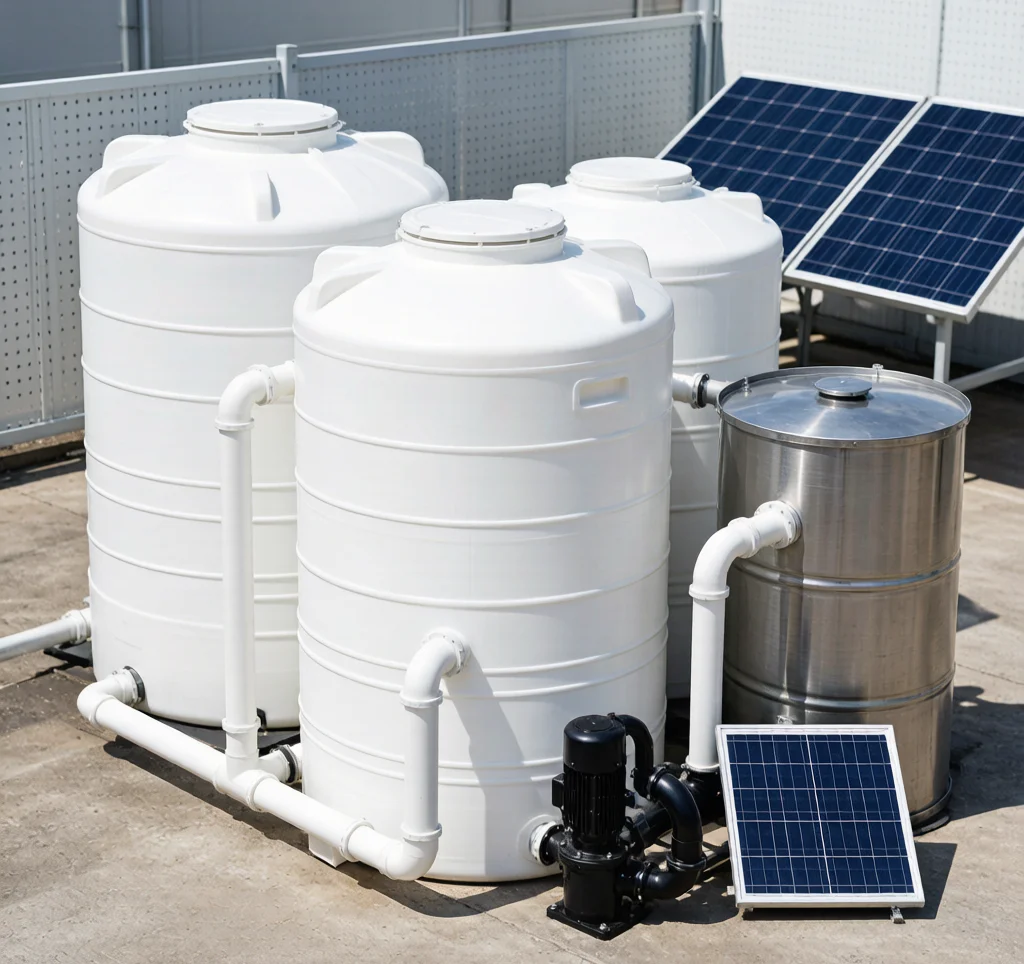
Series vs. Parallel Configuration: In a series setup, water flows from one tank to the next in sequence, which works well for sedimentation or filtration staging. For pure storage capacity, parallel configuration—where multiple tanks share a common inlet and outlet manifold—is more efficient and allows individual tanks to be isolated for cleaning without disrupting supply.
Overflow Protection: Every storage tank must include a properly sized overflow pipe routed to a safe drainage area. The overflow diameter should be at least equal to the inlet diameter to prevent flooding during peak pump output. Additionally, a float switch or level sensor can be integrated with the solar pump controller to automatically stop pumping when the tank is full, preventing wasted energy and potential tank damage.
Additional Tips:
- Install a Venturi screen or mesh filter at the tank inlet to prevent debris entry
- Position the tank inlet above the maximum water line to prevent backflow contamination
- Include a drain valve at the lowest point for periodic cleaning and sediment removal
- Insulate or shade the tank in hot climates to minimize water temperature rise and algae growth
Frequently Asked Questions
1. How big should my storage tank be compared to my solar pump’s daily output?
As a general rule, the storage tank should hold at least 1.5 to 2 times the solar pump’s average daily output. This ensures the tank can capture all water produced during peak sun hours while maintaining a reserve for cloudy periods. For example, if your pump produces 8,000 liters per day, a tank of 12,000 to 16,000 liters is recommended.
2. Can I use multiple smaller tanks instead of one large tank?
Yes. Multiple smaller tanks connected in parallel can be more practical for transportation, installation, and maintenance. They also allow you to expand capacity incrementally as demand grows. The key is to ensure the manifold piping is sized correctly so that all tanks fill and drain evenly. KINBO engineers frequently design multi-tank systems for community water supply projects.
3. Do I need a separate pressure tank in addition to the storage tank?
It depends on your distribution system. If the storage tank is elevated and gravity provides sufficient pressure, a separate pressure tank is not needed. For ground-level installations requiring pressurized delivery, a pressure tank (typically 100–500 liters) should be installed downstream of the storage tank, paired with a booster pump. See our article on solar pump pressure tank sizing for detailed guidance.
Need Help Sizing Your Solar Pump Storage System?
The KINBO engineering team provides free system design consultation, including storage tank sizing, pump selection, and configuration layout. Whether you are planning a small farm installation or a large community water supply project, we can help you optimize performance and cost. Visit our after-sales service page to get started.
August 11, 2026 | Author: KINBO Editorial Team