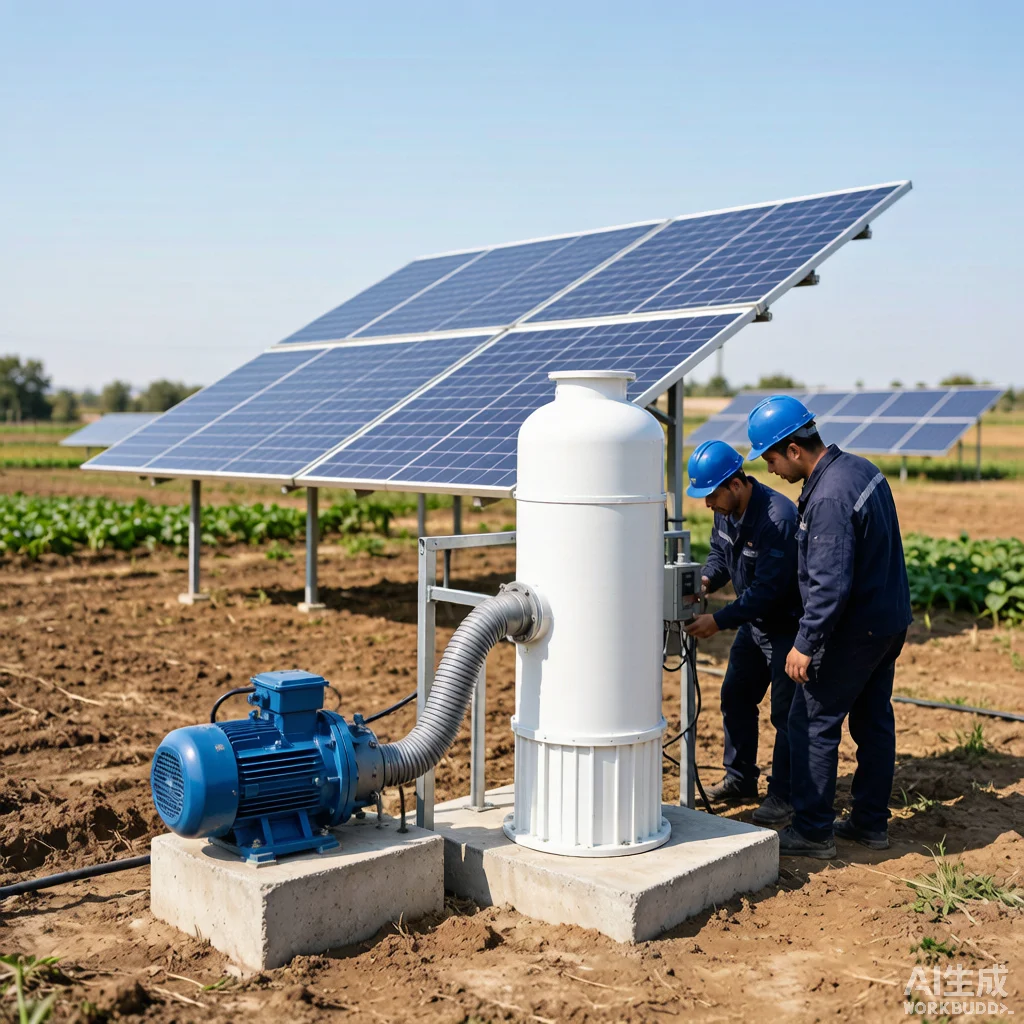
Solar Pumps for Vineyard and Winery Water Management
Introduction
Vineyards and wineries present a uniquely demanding water management profile: seasonal irrigation peaks during veraison, critical frost protection events with zero-failure-tolerance timing, and continuous processing water demand during crush. Solar pumping systems, when properly specified, offer compelling operational and economic advantages for viticulture — elimination of diesel fuel logistics in remote vineyard blocks, alignment of peak irrigation demand with peak solar irradiance, and the ability to deploy distributed pumping stations across terraced terrain without trenching power cables over kilometers of hillside. KINBO has supplied solar pumping solutions to vineyard operations across Mediterranean, Australian, South American, and Californian wine regions, where the convergence of high solar resource and water-conscious viticulture creates ideal conditions for photovoltaic pumping. This article provides a technically rigorous guide to specifying, sizing, and deploying solar pumps for the full vineyard and winery water cycle — from drip irrigation on terraced hillsides to frost protection sprinklers to processing wastewater treatment.
Table of Contents
Vineyard Irrigation Requirements and Water-Use Efficiency
Viticulture irrigation strategy is fundamentally different from broad-acre row crops. The objective is not maximum biomass production but controlled water stress — regulated deficit irrigation (RDI) and partial rootzone drying (PRD) are the dominant protocols in premium wine grape production. Under RDI, water application is deliberately reduced during specific phenological stages (typically post-fruit set to veraison) to restrict vegetative growth, concentrate berry flavors, and manage canopy architecture. Seasonal irrigation water requirements vary dramatically by region and trellis system: cool-climate regions (Burgundy, Oregon, Tasmania) may require only 100–250 mm/season, warm regions (Barossa Valley, Napa, Mendoza) range from 300–600 mm/season, and hot irrigated regions (San Joaquin Valley, Riverland) can demand 600–900 mm/season.
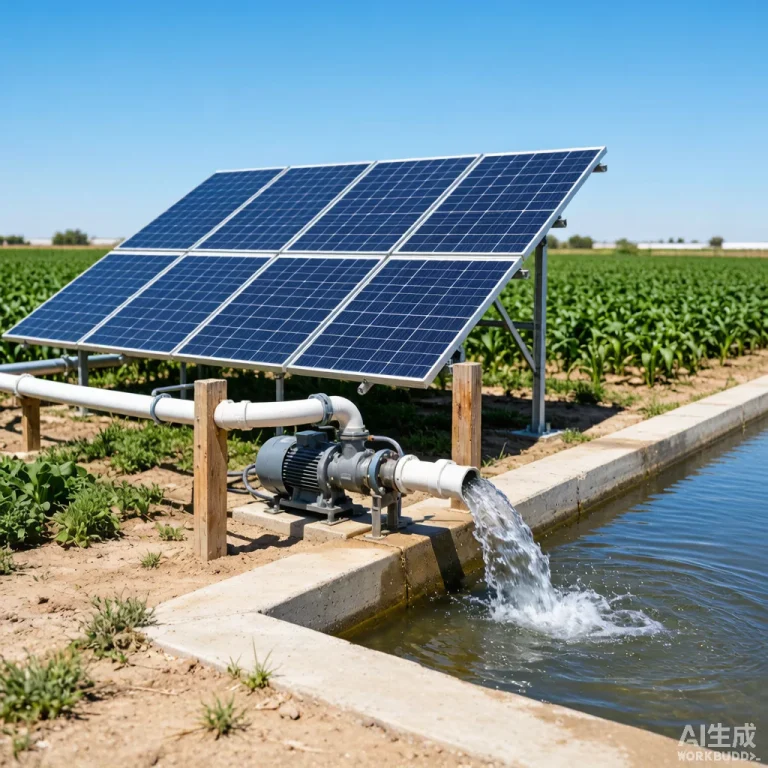
For drip-irrigated vineyards — now the standard for premium wine grape production — the solar pump duty point calculation begins with peak daily evapotranspiration (ETc) during the hottest month. A mature vineyard on a vertical shoot positioned (VSP) trellis in a Mediterranean climate might show peak ETc of 6–8 mm/day. With vine spacing of 2.5 m × 1.8 m (2 222 vines/ha) and drip emitter discharge of 2.0 L/h per emitter at two emitters per vine, the system flow requirement is approximately 8.9 m³/ha/day. For a 20-hectare vineyard block, peak daily demand is 178 m³/day. Converting to pump sizing: if irrigation is scheduled over a 10-hour window coinciding with the solar day, the required pump flow rate is 17.8 m³/h at the total dynamic head (TDH) determined by the irrigation system’s operating pressure plus elevation lift and friction losses.
Drip irrigation network pressure requirements — typically 1.5–2.5 bar (15–25 m) at the drip line inlet — are well matched to solar submersible and surface booster pump operating ranges. KINBO solar pumps with permanent magnet synchronous motors achieve best efficiency in the 10–40 m head range for submersible applications and 20–80 m for surface booster configurations, covering the vast majority of vineyard drip irrigation scenarios. Water-use efficiency gains from solar pumping are not just about energy; the precise flow control enabled by MPPT-driven VFDs allows growers to program irrigation schedules that match the crop coefficient (Kc) curve of the specific grape variety and rootstock combination, minimizing both over-irrigation (which dilutes berry quality and promotes disease) and under-irrigation (which caps yield potential).
Solar Pump Sizing for Hillside Vineyards
Hillside and terraced vineyards — prized for their drainage, sun exposure, and wine quality — introduce head calculation complexity that flat-ground designers often underestimate. A pump lifting water from a valley-floor reservoir or borehole to a drip line at the uppermost terrace must overcome not only the static elevation difference but also the cumulative friction losses in a pipeline that may traverse 500–1 500 meters of variable terrain.
The total dynamic head for a hillside vineyard pumping system can be decomposed as follows: TDH = static lift + irrigation system operating pressure + friction losses in the mainline + friction losses in the submain and lateral lines. Consider a terraced vineyard in Chile’s Colchagua Valley with a water source at 280 m elevation and the highest drip line at 420 m elevation — a static lift of 140 m. Add 20 m for drip system operating pressure (2.0 bar). The mainline pipe, a 2 200-meter HDPE run from the pump to the distribution manifold, produces friction loss that depends on pipe diameter and flow rate. Using the Hazen-Williams equation with C = 140 for HDPE: for a flow of 25 m³/h, DN100 (110 mm OD) pipe yields 2.8 m/100 m friction loss (61.6 m total), while DN80 (90 mm OD) yields 8.1 m/100 m (178.2 m total). The difference between the two pipe sizes — 116.6 m of additional head — can determine whether a single-stage solar pump is sufficient or whether a multi-stage pump (or a booster station mid-slope) becomes necessary.
| Pipe Diameter (HDPE PN10) | Flow 15 m³/h (friction m/100m) | Flow 25 m³/h (friction m/100m) | Flow 40 m³/h (friction m/100m) | Recommended Max Length at 10% Head Budget |
|---|---|---|---|---|
| DN80 (90 mm OD) | 3.2 | 8.1 | 19.0 | ~200 m at 25 m³/h |
| DN100 (110 mm OD) | 1.1 | 2.8 | 6.5 | ~600 m at 25 m³/h |
| DN125 (140 mm OD) | 0.4 | 1.0 | 2.4 | ~1 600 m at 25 m³/h |
| DN150 (160 mm OD) | 0.2 | 0.4 | 1.0 | ~4 000 m at 25 m³/h |
A critical design consideration for solar-powered hillside systems is that pump head varies with solar irradiance throughout the day. At 600 W/m² (morning or light cloud), a solar pump produces approximately 60% of its rated power. The system design must account for this — the minimum functional irradiance should still generate sufficient head to overcome the static lift to the lowest operating terrace. If the pump’s head-capacity curve drops below the system resistance curve at low irradiance, the pump will produce zero flow until solar input increases, effectively shortening the usable irrigation window. A conservative design approach is to size the pump so that the intersection of the 60%-of-rated-power pump curve with the system resistance curve yields at least 50% of design flow — ensuring the system delivers meaningful irrigation even during sub-peak solar conditions. For extreme-elevation vineyards (static lifts exceeding 200 m), multi-pump configurations with intermediate storage tanks at terrace levels provide both operational flexibility and hydraulic feasibility that a single-stage lift cannot achieve.
Frost Protection Pumping Systems
Spring frost during budbreak and early shoot development is the most financially consequential weather risk in cool-climate viticulture. A single frost event during the critical two-week window after budbreak can destroy 50–80% of the season’s crop, with economic losses for a 20-hectare premium vineyard easily exceeding USD 200,000–500,000. Active frost protection via overhead sprinklers remains the most widely deployed method, relying on the latent heat of fusion released when water freezes (334 kJ per liter) to maintain plant tissue temperature at approximately 0°C as long as a continuous liquid-ice mixture is maintained on the buds and shoots.
Overhead frost protection sprinkler systems demand high instantaneous flow rates — typically 3.5–5.0 mm/hour (35–50 m³/ha/hour) for full-coverage sprinklers — significantly exceeding irrigation demand. For a 10-hectare frost-protected block, the pump must deliver 350–500 m³/h, a flow rate that is one to two orders of magnitude greater than drip irrigation requirements. This flow-intensity mismatch is a fundamental challenge for solar pumping: a system sized for irrigation is grossly undersized for frost protection, while a system sized for frost protection is prohibitively oversized (and expensive) for the 95% of operating hours spent on irrigation.
Several hybrid configurations address this practical reality. The most common approach uses grid or diesel generator backup for the frost protection pumps while maintaining a dedicated solar system for daily irrigation — recognizing that frost events typically occur at 3:00–7:00 AM when solar irradiance is zero or negligible, making pure solar frost protection impractical without massive battery storage. A more integrated solution for off-grid vineyards pairs a solar pump with elevated storage: the solar system runs during daylight hours to fill an elevated reservoir or tank at a high point on the property. During a frost event, water is released by gravity through the sprinkler network, eliminating the need for a high-flow pump during the frost window. A 10-hectare vineyard requiring 4 hours of frost protection at 40 m³/ha/hour needs 1 600 m³ of storage — a reservoir of approximately 32 m × 32 m × 1.6 m depth, which is feasible for many vineyard sites with suitable topography.
KINBO has supported vineyard frost protection systems through solar-powered reservoir filling and pressure boosting configurations. The recommended design sequence is: (1) determine the frost protection flow and duration based on historical frost event records and vineyard block layout; (2) calculate required storage volume with a 20% safety factor for consecutive frost nights; (3) size the solar pump to fill the reservoir over the available daylight window (typically 6–8 hours) on the day preceding the frost risk period; (4) install automated frost alarms and valve controls that trigger gravity-fed sprinklers when air temperature drops to 1.5°C (wetting point) and continue until air temperature rises above 1°C and all ice has melted. A well-designed gravity-fed frost protection system with solar-powered reservoir filling provides insurance-grade reliability with zero ongoing energy cost — a compelling proposition for premium wine producers where the cost of a single unmitigated frost event far exceeds the capital investment.
Winery Wastewater and Processing Water Solutions
Beyond vineyard irrigation, the winery facility itself generates distinct water management requirements during the harvest and processing season — typically an 8–12 week period from August through October in the Northern Hemisphere, and February through April in the Southern Hemisphere. Winery wastewater is characterized by high organic loading (BOD5 of 500–5 000 mg/L, COD of 800–15 000 mg/L), variable pH (3.5–6.5 due to organic acids), elevated total dissolved solids (TDS) from cleaning chemicals, and highly seasonal flow patterns driven by crush schedules.
Solar pumps serve three distinct roles in winery water management. First, process water transfer: moving clean water from boreholes, surface sources, or municipal connections to holding tanks for grape washing, barrel cleaning, tank sanitation, and bottle rinsing. A medium-sized winery processing 500 tonnes of grapes per crush typically uses 2–5 L of water per liter of wine produced, resulting in daily water demand peaks of 20–50 m³/day during crush. A solar pump with 5–10 m³/h capacity at moderate head (30–50 m) can reliably meet this demand when paired with adequate buffer storage.
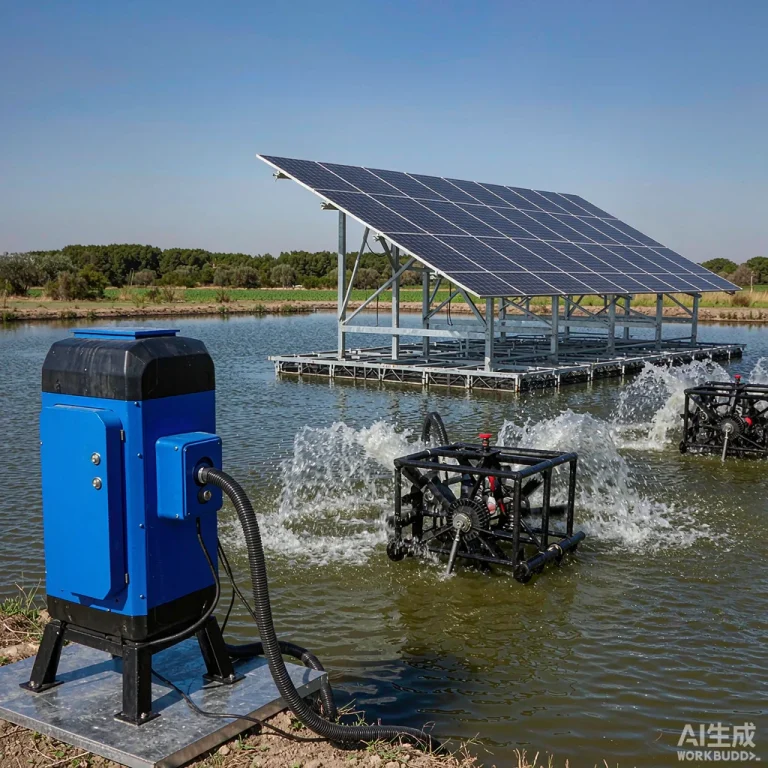
Second, wastewater collection and recirculation: pumping winery effluent from sumps and collection pits to primary treatment (screening, dissolved air flotation or settling) and secondary treatment (constructed wetlands, aerated lagoons, or membrane bioreactors). The critical specification for wastewater transfer pumps is solids-handling capability and corrosion resistance — 316 stainless steel or duplex construction for all wetted components, with semi-open or vortex impeller designs that pass solids up to 25–50 mm without clogging. Solar-powered aerators (surface or sub-surface) in treatment lagoons represent another application where the alignment of peak solar irradiance with peak biological oxygen demand provides natural process synergy.
Third, treated water reuse pumping: returning treated winery wastewater to vineyard irrigation zones, closing the water cycle loop. Regulatory requirements for treated effluent reuse in vineyards vary by jurisdiction (e.g., California Title 22, EU Water Reuse Regulation 2020/741) and typically mandate pathogen reduction equivalent to <10 E. coli CFU/100 mL and turbidity <2 NTU. A solar booster pump station at the treatment facility outlet, drawing from a treated water holding tank, can distribute reclaimed water to vineyard irrigation blocks through the same drip network used for primary irrigation — effectively doubling the utility of the solar pumping infrastructure. This integrated water management approach reduces the vineyard’s net water footprint by 40–60% in well-designed systems, delivering both environmental compliance and operational cost savings that accrue over the 25+ year operating life of the solar pumping equipment.
Frequently Asked Questions
Q: Can solar pumps handle the seasonal peak demand of vineyards?
A: Yes, and in fact the seasonal alignment is one of the strongest technical arguments for solar pumping in viticulture. Peak vineyard water demand occurs during the hottest months — July and August in the Northern Hemisphere, January and February in the Southern Hemisphere — which coincide with the highest monthly solar irradiance values. The daily irrigation peak (typically 10:00–16:00) also aligns with the peak solar generation window. The design approach is to size the solar array and pump for the maximum daily water volume required during the peak irrigation month, then use buffer storage (typically 2–3 days of peak demand) to provide operational flexibility for cloudy days and off-peak irrigation scheduling. For drip-irrigated vineyards, the seasonal flow variation is more gradual than for flood or furrow irrigation, reducing the mismatch between fixed pump capacity and variable demand. During the non-irrigation season (dormancy), the solar array can be used for other vineyard electricity loads — workshop power, electric vehicle charging, or grid export where net metering regulations permit — maximizing annual utilization of the capital investment.
Q: What backup is needed for frost protection when using solar pumps?
A: Pure solar-direct frost protection pumping is not practical because frost events occur during pre-dawn hours (3:00–7:00 AM) when solar irradiance is zero, and the flow rates required (35–50 m³/ha/hour) would demand an impractically large battery storage system. A 10-hectare vineyard needing 400 m³/h for 4 hours of frost protection would require approximately 1 600 kWh of stored energy — equivalent to roughly USD 250,000–400,000 in lithium battery storage at current prices, which is rarely economical for seasonal-use applications. The recommended backup strategy depends on the vineyard’s infrastructure context. For grid-connected sites, a grid-powered electric pump with automatic transfer switch provides the most reliable and lowest-capital-cost frost protection, with the solar pump dedicated to daily irrigation. For off-grid sites, the most cost-effective approach is a solar-powered reservoir filling system: the solar pump fills an elevated storage reservoir (or pressurizes a hydro-pneumatic tank farm) during daylight hours, and frost protection operates on gravity flow or stored pressure during the pre-dawn frost window. Diesel-powered portable pump sets on standby provide a secondary backup layer. The key design principle is that frost protection is an emergency-response system, not a daily-use system — it should be engineered for extreme reliability during rare events, which is fundamentally different from the duty cycle optimization appropriate for irrigation pumping.
Q: How does elevation affect solar pump performance in mountain vineyards?
A: Elevation affects solar pump system design through three independent mechanisms. First, static head increases directly with elevation difference between water source and delivery point — each meter of elevation gain requires approximately 0.098 bar (1.42 psi) of additional pressure, and this head cost is constant regardless of pipe size or flow rate. Mountain vineyards in regions such as Mendoza (Argentina), Alto Adige (Italy), or Stellenbosch (South Africa) with elevation differentials of 200–500 meters between water source and uppermost terraces require multi-stage submersible or surface pumps with rated heads in the range of 250–550 m — a technically demanding specification that narrows the field of qualified pump suppliers. Second, air density decreases with elevation (approximately 9% per 1 000 m), which reduces the atmospheric pressure available for pump suction — NPSHa (Net Positive Suction Head available) decreases, increasing the risk of cavitation in surface pumps. For a vineyard at 1 500 m elevation, the atmospheric pressure is approximately 8.5 m water column versus 10.3 m at sea level, reducing the suction lift capability by roughly 1.8 m. Third, solar irradiance increases with elevation due to reduced atmospheric absorption — typically 5–8% higher at 1 500 m compared to sea level under clear-sky conditions — which partially offsets the increased pumping energy requirement from elevation. The net effect is that while mountain vineyards demand higher-head pumps and therefore larger solar arrays, the higher solar resource at elevation provides a compensating efficiency gain. KINBO‘s high-head solar pump series, with multistage centrifugal designs rated for heads up to 450 m, is specifically engineered for these elevated-terrain viticulture applications, with impeller materials selected for the low-NPSH operating conditions characteristic of high-altitude installations.
Design a solar pumping solution for your vineyard’s complete water cycle — from hillside irrigation to frost protection to winery processing — with technical support from KINBO. Contact our agricultural water management team for a site-specific system sizing and payback analysis.