Solar Water Pumps for Rural School Water Supply Systems: Design and Implementation
Introduction
Access to clean, reliable water remains one of the most pressing challenges for rural schools in developing regions. According to UNICEF, nearly 300 million children worldwide attend schools without basic drinking water services, forcing students to carry water from home or rely on contaminated sources. The consequences extend far beyond thirst — waterborne diseases, poor sanitation facilities, and reduced school attendance disproportionately affect children in underserved communities.
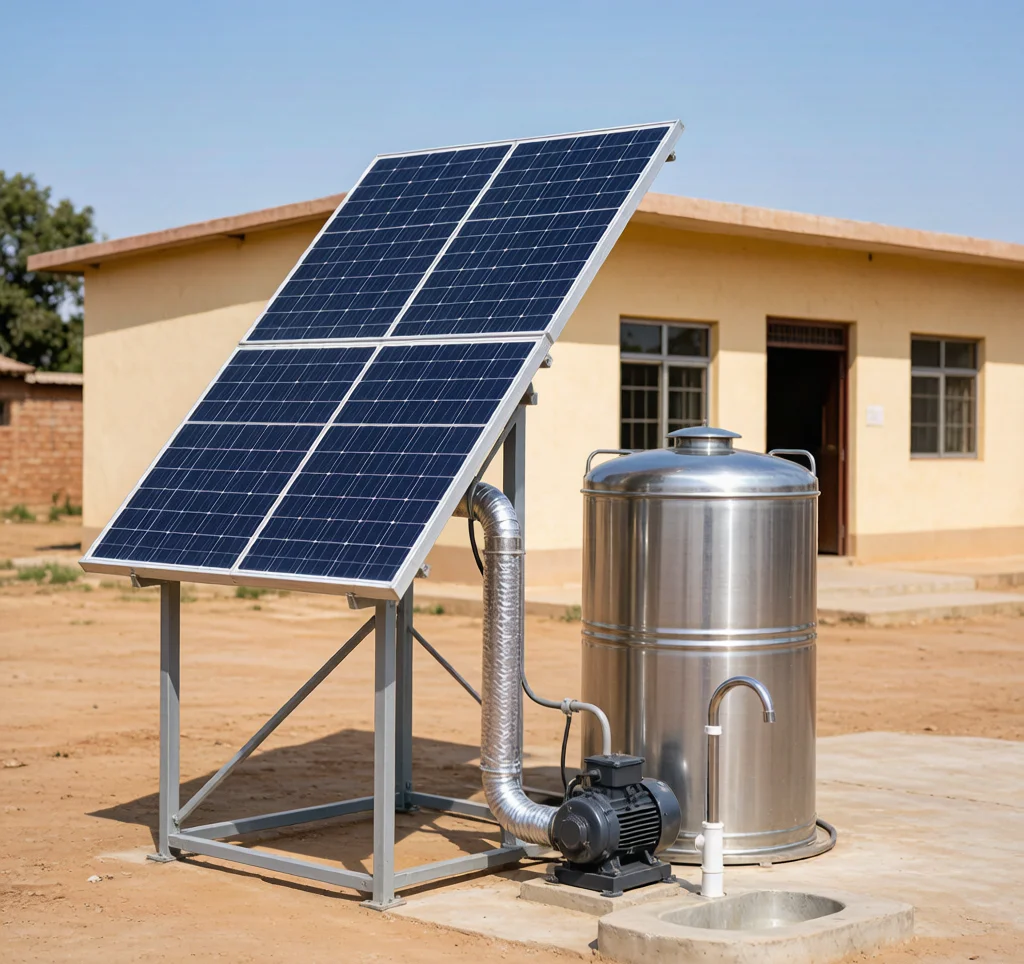
Solar-powered water pump systems have emerged as a transformative solution for this global challenge. By harnessing abundant sunlight, these systems deliver consistent water supply for drinking, cooking, sanitation, and handwashing without the recurring fuel costs of diesel pumps or the grid-dependency of electric pumps. KINBO has been at the forefront of this movement, engineering solar water pumping solutions specifically tailored for institutional applications like schools and community centers. With over a decade of experience serving rural communities across Africa, Asia, and Latin America, KINBO understands the unique technical, economic, and social factors that determine project success. Learn more about our drinking water solutions for institutional and community use.
Table of Contents
Water Challenges in Rural Schools
Rural schools face a compounding set of water-related challenges that undermine both educational outcomes and public health:
- Limited water access: The WHO reports that 31% of schools in least-developed countries lack basic drinking water services. Children often walk 1–3 km round-trip to fetch water, losing valuable classroom time.
- Health and disease burden: Contaminated water sources expose students to waterborne diseases such as diarrhea, cholera, and typhoid. The WHO estimates that improved water, sanitation, and hygiene (WASH) in schools could reduce diarrheal disease by up to 30% among students.
- Inadequate sanitation facilities: Without running water, school latrines and handwashing stations become unusable, particularly for adolescent girls. UNICEF data shows that 23% of schools globally lack basic sanitation, and the absence of private, water-equipped facilities contributes to higher dropout rates among girls during menstruation.
- Food preparation constraints: School meal programs — a critical incentive for attendance in low-income areas — require safe water for cooking and cleaning. When water is scarce or unsafe, these programs are compromised.
- Recurring operational costs: Schools that rely on diesel-powered pumps or water tanker deliveries face unpredictable and often unaffordable fuel expenses, making long-term water access unsustainable.
These interrelated challenges highlight the urgent need for a self-sufficient, low-maintenance water supply system. Solar water pumps address this need by providing a one-time investment with minimal ongoing operational costs, making them ideal for resource-constrained educational institutions.
System Design Considerations
Designing a solar water pump system for a rural school requires careful assessment of several key factors: student population, daily water demand, groundwater conditions, storage capacity, and sanitation facility requirements. A properly sized system ensures reliability year-round while avoiding costly over-engineering.
Key Sizing Factors
Daily water demand is calculated based on student and staff population, with per-capita allowances for drinking (15–20 L/person/day), cooking (10–15 L/person/day), sanitation and handwashing (20–30 L/person/day), and cleaning (10–15 L/person/day). A typical rural school requires approximately 50–80 liters per person per day, totaling 5,000–60,000 liters daily depending on enrollment.
Storage capacity should hold at least 1–2 days of demand to ensure supply during cloudy periods. Pump power is determined by the required flow rate, total dynamic head (borehole depth plus pipeline friction losses), and solar irradiance at the site. Sanitation facility integration — including flush toilets, handwashing basins, and kitchen taps — must be factored into the total demand calculation.
The table below compares recommended system configurations by school size:
| School Size | Daily Demand (L) | Pump Power (kW) | Tank Size (m³) | Estimated Cost (USD) |
|---|---|---|---|---|
| Small (<200 students) | 8,000–15,000 | 0.75–1.1 | 10–15 | $3,500–$5,500 |
| Medium (200–500 students) | 15,000–35,000 | 1.5–2.2 | 20–35 | $6,500–$10,000 |
| Large (500–1000 students) | 35,000–70,000 | 2.2–4.0 | 40–70 | $11,000–$18,000 |
Note: Costs include solar panels, pump, controller, storage tank, basic piping, and installation. Actual figures vary by location, borehole depth, and site conditions.
Implementation Case Studies
Real-world deployments demonstrate the versatility and impact of solar water pump systems across diverse geographic and socioeconomic contexts. Below are three representative cases from Kenya, India, and the Philippines.
Case Study 1: Kenya — Migori County Primary School
School population: 340 students and 18 staff
System specs: 1.5 kW DC solar submersible pump, 30 m³ overhead storage tank, 80 m borehole depth
Outcome: The system, commissioned in 2023, delivers approximately 22,000 liters per day, serving drinking fountains, a school kitchen, and 12 gender-segregated latrines with handwashing stations. School attendance increased by 12% within the first academic year, and the incidence of water-related illness dropped significantly. The previous diesel pump cost roughly $1,200/year in fuel — now eliminated entirely.
Case Study 2: India — Rajasthan Government School
School population: 720 students across primary and middle grades
System specs: 3.0 kW DC solar submersible pump, 50 m³ storage tank, 120 m borehole depth
Outcome: Installed in 2022 with support from an NGO partner, this system supplies 55,000 liters daily to the school and serves as a community water point after school hours. The project included flush toilets, a midday meal kitchen tap, and a drinking water filtration unit. The school reported a 20% reduction in absenteeism among female students, largely attributed to improved sanitation facilities. Read more about solar pump system applications.
Case Study 3: Philippines — Mindanao Island School
School population: 185 students and 12 staff
System specs: 0.75 kW DC solar surface pump, 10 m³ storage tank, spring-fed source at 30 m lift
Outcome: This 2024 installation serves a remote island school that previously depended on irregular rainwater harvesting. The solar pump system now provides 8,500 liters daily for drinking, handwashing, and a small school garden that supplements the feeding program. The school saved the equivalent of $840/year previously spent on bottled water deliveries.
Cost Analysis and Funding Options
Understanding the financial profile of a solar school water project is essential for planning and securing funding. While the upfront investment is higher than a diesel pump, the total cost of ownership over a 10-year period is dramatically lower.
Cost Breakdown
- Initial investment: Solar pump system (panels, pump, controller) accounts for approximately 50–60% of total cost; storage tank and piping 20–25%; installation and labor 15–20%; monitoring and accessories 5–10%.
- Operating savings vs. diesel: A diesel pump of comparable capacity consumes $800–$2,000 in fuel annually, plus $200–$500 in maintenance. A solar pump system has near-zero fuel costs and minimal maintenance — typically $50–$150/year for cleaning and inspection.
- Payback period: Compared to a diesel equivalent, most school solar pump systems achieve payback within 3–5 years. Over a 15–20 year system lifespan, total savings range from $12,000 to $35,000 depending on system size and local fuel prices.
- CO₂ reduction: A typical school system avoids 2–5 tons of CO₂ emissions annually compared to diesel operation.
Funding Options
Securing financing for rural school water projects often requires a blended approach combining multiple sources:
- Government programs: Many national governments, through ministries of education or water resources, allocate grants for WASH in schools. Countries like India, Kenya, and the Philippines have dedicated rural school water programs.
- NGO and development partner grants: Organizations such as UNICEF, WaterAid, and the Global Partnership for Education provide co-financing for school water infrastructure. KINBO works alongside these partners to supply technically appropriate solar pumping equipment and installation support.
- Corporate CSR funds: Corporations with water access or education-focused CSR initiatives frequently co-fund school water projects. KINBO assists in project design and technical documentation to support CSR funding applications.
- Community contributions: Local communities can contribute labor, site preparation, and minor infrastructure (latrines, piping) to reduce overall project costs and ensure local ownership.
For after-sales technical assistance, maintenance planning, and spare parts support, visit the KINBO After-Sales Service page.
Frequently Asked Questions
Q1: How much water does a rural school need per day?
A typical rural school requires approximately 50–80 liters per person per day for drinking, cooking, sanitation, and cleaning. For a school of 300 students and 20 staff, the daily demand would be roughly 16,000–25,600 liters. This figure should be adjusted upward if the system also serves a boarding facility or community water point.
Q2: What happens during cloudy or rainy days?
Solar pump systems are designed with storage tanks sized for 1–2 days of autonomy. During cloudy days, the pump operates at reduced output, but the stored water continues to meet school needs. In regions with extended rainy seasons, a slightly oversized tank or a hybrid backup option (small generator or grid connection) can ensure uninterrupted supply. KINBO systems include MPPT controllers that optimize performance even under low-light conditions.
Q3: How long do solar water pump systems for schools last?
Solar panels typically carry a 25-year performance warranty, while the pump motor and controller have an expected lifespan of 7–15 years depending on water quality and maintenance. Storage tanks made of food-grade polyethylene or stainless steel last 15–20 years. With routine maintenance — panel cleaning, controller inspection, and periodic pump servicing — a well-designed school system provides reliable water for decades.
Ready to Power Your School’s Water Supply?
Contact KINBO today for a customized solar water pump system designed for your school’s population, water demand, and site conditions. Our engineering team provides end-to-end support from system sizing to after-sales maintenance.
August 11, 2026 | Author: KINBO Editorial Team