Solar Pump System Voltage Selection: 12V vs 24V vs 48V vs 96V and How to Choose Right
Introduction
When specifying a solar water pump, most buyers fixate on flow and head and forget the single parameter that quietly decides total cost: system voltage. The same 1 kW of pump power can be delivered at 12 V drawing 83 A, or at 96 V drawing just 10 A—and that difference dictates cable thickness, copper spend, controller rating, and how far you can run the line before voltage drop strangles performance. KINBO sees the consequences constantly: a 24 V system stretched 80 meters on undersized wire that overheats and wastes a third of the panel energy, or a 48 V build that should have been 96 V once the farmer added a second tank. This guide explains the physics in plain terms, gives a ready-to-use selection table, and shows where each voltage band fits. Get it right at design time and you save money and headaches for the life of the system; get it wrong and you either overpay for copper or watch the pump limp along under voltage starvation.
The Physics: Power, Current and Loss
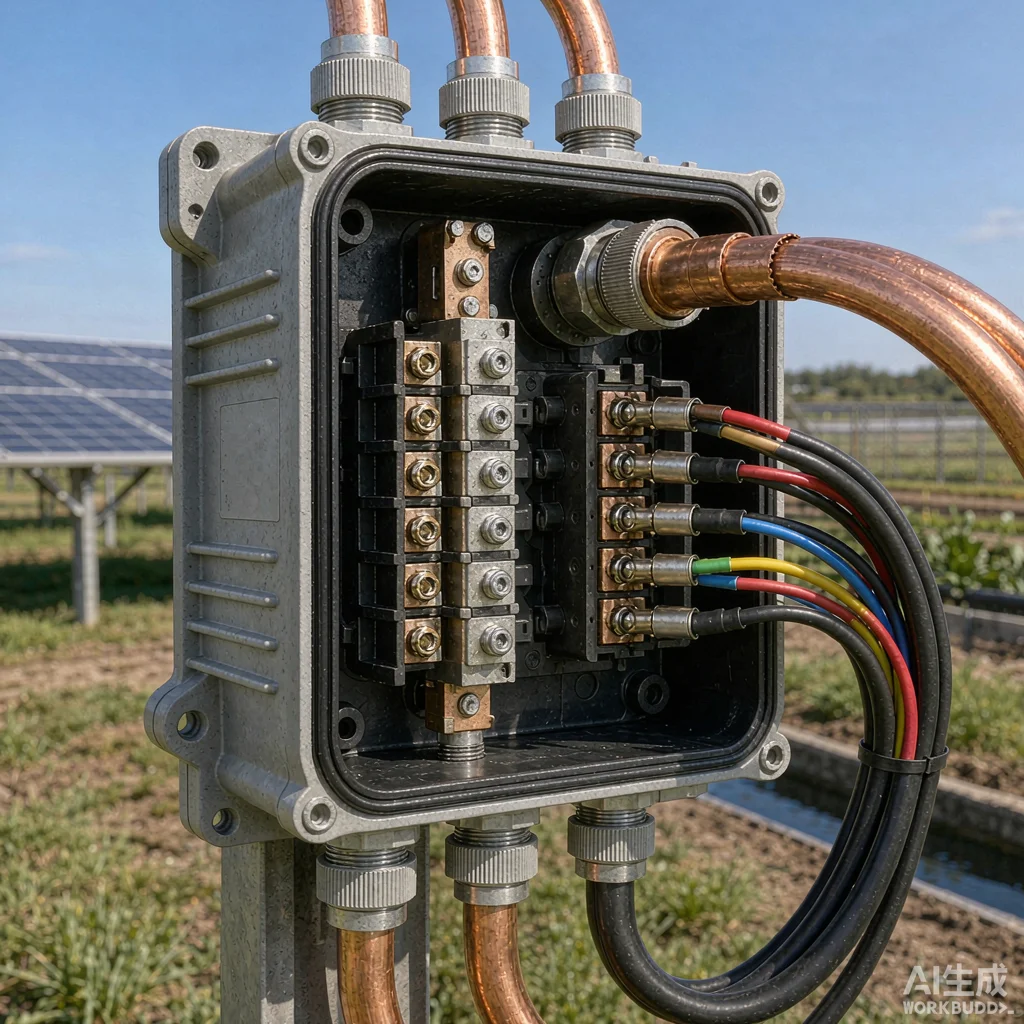
The rule that governs everything is P = V × I. For a fixed pump power, raising voltage lowers current, and because cable loss follows I²R, halving the current cuts copper heating to one quarter. That is why a 48 V system can use dramatically thinner wire than a 12 V system for the same wattage and run.
Why Low Voltage Costs More Than It Looks
At 12 V a 600 W pump pulls 50 A. Keeping voltage drop under 3% over 30 meters needs around 10 mm² copper—already bulky. Push that same run to 60 meters and you need 25 mm² or more, or accept the pump starving. At 48 V the same 600 W draws 12.5 A and a 4 mm² cable does the job. The solar pump system design page covers head and flow; voltage is the missing half of that calculation.
Voltage Bands and Where They Fit
12V Systems
Suitable for tiny loads—garden fountains, single livestock troughs, under 150 W. Simple, cheap controllers, but impractical beyond short runs. Avoid for anything needing real pressure.
24V Systems
The small-farm default up to roughly 400 W. Good for shallow wells and short cable routes under 30 m. Still current-hungry if you extend the line.
48V Systems
The sweet spot for most agricultural and irrigation pumps from 400 W to about 1.5 kW. Reasonable cable cost, efficient controllers, and easy to find compatible brushless DC motors.
96V (and 110V) Systems
For 1.5 kW to 5 kW+ stations, long cable runs, or high-head deep wells. Higher component cost but the only sane choice when distance or power rules out lower bands.
| Voltage | Typical Power | Max Practical Run | Best Use |
|---|---|---|---|
| 12 V | <150 W | <15 m | Fountains, tiny troughs |
| 24 V | 150–400 W | <30 m | Shallow wells, small farms |
| 48 V | 400 W–1.5 kW | 30–80 m | Irrigation, livestock |
| 96 V | 1.5–5 kW+ | 80 m+ | Deep wells, large stations |
Selection Table by Power and Distance
Use this quick matrix to pick a starting voltage before you size the cable precisely.
| Pump Power | Run <30 m | 30–80 m | >80 m |
|---|---|---|---|
| Up to 200 W | 12 V | 24 V | 24 V |
| 200–600 W | 24 V | 48 V | 48 V |
| 600 W–1.5 kW | 48 V | 48 V | 96 V |
| 1.5 kW+ | 48 V | 96 V | 96 V |
Cable Sizing and Voltage Drop
After choosing voltage, verify the drop. Allow a maximum 3% loss on the DC run from array to controller and another 3% on the controller-to-pump line. The formula is simple: drop = I × R, where R depends on cable length and cross-section. KINBO’s configurator does this automatically, but the rule of thumb holds—when in doubt between two bands, go higher. A 96 V controller costs little more than 48 V, while the copper you save on a long run often pays the difference.
Scaling and Future Expansion
Plan for growth. If you may double the array or add a second pump later, start one band higher than today’s load demands. Retrofitting voltage means swapping the controller and motor—far costlier than sizing up at the start. KINBO offers 48 V/96 V dual-rated controllers on larger kits precisely so expansion stays painless.
Frequently Asked Questions
Can I mix 12V panels to make 48V?
Yes—series-connect panels to reach the system voltage. Four 12 V nominal panels in series give roughly 48 V. Match the controller’s max input voltage and watch the cold-weather open-circuit rise.
Is higher voltage more dangerous?
Below 120 V DC the shock risk is lower than household AC, but arcs can still injure. Proper fusing, disconnects, and enclosures matter more than the band you choose. Always install a DC breaker on the array side.
Why does my 24V pump underperform far from the panels?
Voltage drop on thin cable starves the controller. Either shorten the run, enlarge the cable, or step up to 48 V. Measure voltage at the pump under load—if it sits well below nominal, drop is the culprit.
Does voltage affect pump efficiency?
Indirectly. Higher voltage lets you use thinner cable with less loss, so more panel energy reaches the motor. The motor itself is usually rated for a band; staying within it keeps efficiency peak.
Get the Right Voltage the First Time
KINBO sizes voltage, cable, and controller together from your flow, head, and run length so the system delivers full power from day one. Send us your site parameters and we will return a complete bill of materials.
Related Articles
Solar Pump Flow Rate and Head Performance Curves Explained